
What Alzheimer’s Research Is Really Trying to Build Right Now
When Alzheimer’s research makes the news, it can feel like the headline is either too hopeful or too frightening. One day there is talk of a breakthrough. The next day there is talk of risk, cost, or uncertainty. For families trying to understand memory loss, diabetes, insulin resistance, or brain health, that can be exhausting.
So let’s slow it down. As of this article’s publication date, April 18, 2026, the most interesting translational Alzheimer’s research is not pointing to one simple cure. It is pointing toward something more practical: earlier detection, better staging, safer trial design, more personalized treatment decisions, and a clearer picture of what is happening in the brain before symptoms become obvious.
That may sound technical, but the everyday meaning is simple. Researchers are trying to answer questions families already ask: Is this really Alzheimer’s disease? Is something else happening too? How early can we tell? Who might benefit from treatment? Who might be harmed? And how do we test new therapies without exposing people to unnecessary risk?
This article builds on our conversations about Type 3 Diabetes, the diabetes-Alzheimer’s connection, and insulin resistance and cognitive decline. It is not meant to diagnose anyone or replace a clinician. It is here to make high-level science feel less like a locked door.

The Big Shift: From One Diagnosis to a Clearer Biological Picture
For a long time, dementia diagnosis depended heavily on symptoms: memory changes, language problems, confusion, daily function, and patterns noticed by family or clinicians. Those clues still matter. But they do not always tell the whole story.
Many older adults have more than one brain process happening at the same time. Alzheimer’s changes may overlap with vascular disease, Lewy body disease, Parkinson’s-related changes, frontotemporal dementia, past stroke, depression, sleep problems, medication effects, or metabolic problems. That is one reason a person’s symptoms can be confusing, and it is also why a single label may not fully explain what is happening.
A large Nature Medicine study, highlighted by Lund University on April 1, tested whether a blood-based protein pattern could help sort through that complexity. The research team built an AI model using plasma proteomics, which means it looked at thousands of proteins measured from blood. The model was trained on data from 17,187 patients and control participants and was designed to estimate probabilities across several dementia-related conditions at the same time, not just Alzheimer’s disease alone. You can read the study, A deep joint-learning proteomics model for diagnosis of six conditions associated with dementia, and the Lund University summary.
The honest takeaway is not, “A blood test can now solve dementia.” The authors themselves were careful that current blood protein measurements are not enough on their own. The real takeaway is more grounded: blood may eventually help clinicians see a more detailed biological pattern, especially when combined with memory testing, imaging, medical history, and careful clinical judgment.

Why Tau Timing Matters
If amyloid is often described as one of the earliest Alzheimer’s signals, tau is often closer to the story families recognize: where brain cells are under stress, where memory networks are changing, and how the disease may be moving over time.
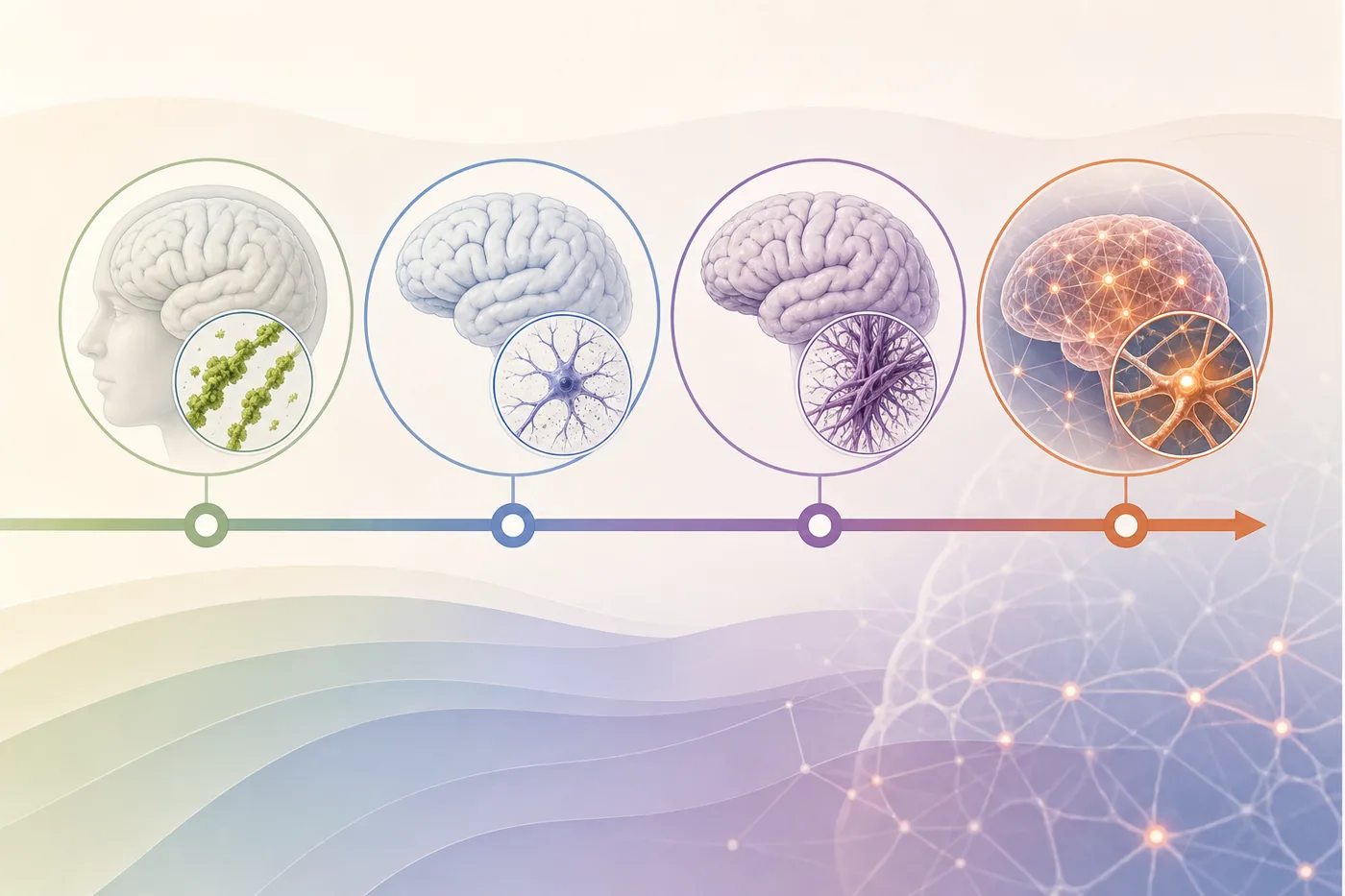
One April 9 Nature Communications paper followed different tau-related markers across the Alzheimer’s disease continuum. In plain English, the researchers were asking: Which tau signals tend to appear early, which ones show up later, and which ones may track the buildup of tau tangles more closely?
The study found that one tau measure, p-tau217, tended to change early, around the time amyloid was becoming detectable. Other tau measures appeared to line up more with later biological events, including tau burden in the brain. That matters because a future clinician or trial team may not only ask, “Is Alzheimer’s biology present?” They may also ask, “Where is this person in the disease process?” The study is here: Trajectories of plasma and CSF MTBR-tau243 and phosphorylated-tau species across the Alzheimer’s disease continuum.
Think of it like weather radar. A single marker might tell you a storm exists. A better set of markers may help show whether it is forming, moving, intensifying, or already passing through a vulnerable area. That does not make treatment simple, but it can make research and clinical decisions more precise.
The Earliest Stage Is Still Complicated
Another April 10 study looked at people who did not have cognitive symptoms but did show early Alzheimer’s biology. This is one of the hardest parts of modern Alzheimer’s research because it raises delicate questions. If someone feels fine but has biological signs of risk, what should that information mean? Should they enter a prevention trial? Should they change medical care? How much certainty is enough?
The study used data from the A4 Study and examined whether early markers such as plasma p-tau217 and amyloid PET could help predict later tau buildup, brain atrophy, and cognition in clinically unimpaired people. The useful idea is not that everyone should rush to be tested. The useful idea is that prevention trials need better ways to identify who is truly at risk and who may be most appropriate for a study. The paper is Continuum of Core 1 biomarkers in preclinical Alzheimer’s disease.
This is where caution matters. Earlier detection can be powerful, but it can also create anxiety if the result is not clearly actionable. A biomarker is not a crystal ball. It is one piece of evidence that needs context: age, symptoms, family history, vascular health, diabetes risk, sleep, mood, medications, imaging, and a clinician who can explain what the test can and cannot say.
That is why our everyday prevention articles still matter. Blood sugar awareness, sleep, movement, stress management, and nutrition are not magic shields. But they are practical ways to support the brain and body while science continues to improve. You can keep exploring with our guides on glucose metabolism and brain health, daily blood sugar control, small wellness habits, and walking for health.

Better Tests Could Make Trials Smarter
Clinical trials are where promising ideas meet reality. They are also where Alzheimer’s research has learned some hard lessons. A trial may fail because the treatment does not work. But it can also struggle because the wrong people were enrolled, the disease stage was too late, the outcome measure was too blunt, or the trial could not detect meaningful change soon enough.
That is why researchers are pairing biology with more practical testing tools. One April 2026 paper examined whether a brief digital memory assessment combined with plasma pTau217 could help identify cognitively unimpaired, amyloid-positive older adults at higher risk for decline. The goal is not to replace a clinician with an app. The goal is to make trials more efficient by finding the right participants earlier and measuring change with more sensitivity. The article is Digital memory assessments and plasma pTau217 enable efficient preclinical Alzheimer’s trials.
Several prevention-oriented trials are already built around this earlier-detection idea, including the AHEAD 3-45 lecanemab study and the TRAILBLAZER-ALZ 3 donanemab study. These trials do not prove that prevention treatment works. They are asking whether treatment before obvious symptoms can slow biological or cognitive change enough to matter.
That distinction is important. A trial is a question, not an answer. If you are ever considering one, use resources such as Alzheimers.gov clinical trials information and talk with a qualified clinician who can help you understand eligibility, risks, benefits, time commitment, and alternatives.

Safety Is Part of Progress
Any honest article about Alzheimer’s translation has to talk about safety. Anti-amyloid medicines have changed the field, but they are not simple treatments. They are generally studied for people with early Alzheimer’s disease, confirmed amyloid biology, and careful medical monitoring. They can also carry risks, including amyloid-related imaging abnormalities, often called ARIA.
ARIA can involve swelling or small bleeding changes seen on MRI. It is often asymptomatic, but it can sometimes be serious. This is why treatment decisions require imaging, risk assessment, medication review, and a clinician who understands the person’s full medical picture. The FDA prescribing information for Leqembi and Kisunla includes ARIA warnings and treatment-stage details.
An April 3 review looked at ARIA from a neurovascular point of view, especially the overlap between Alzheimer’s disease, cerebral amyloid angiopathy, and treatment-related risk. That may sound specialized, but the practical message is familiar: the brain’s blood vessels matter. Vascular health, past bleeding risk, MRI findings, genetics, and other health factors can influence whether a therapy is reasonable for a particular person. You can read the review here: Drug-Induced Amyloid-Related Imaging Abnormalities: A Neurovascular Perspective on Risk Assessment.
This is not meant to scare anyone away from treatment conversations. It is meant to make the conversation more realistic. Good medicine is not only about finding a promising drug. It is also about knowing who should receive it, who should not, how to monitor safely, and how to respect the person behind the scan.

Where This Connects to Diabetes and Daily Life
Mindful Diabetes keeps returning to Alzheimer’s research because brain health and metabolic health often meet in everyday life. Insulin resistance, blood sugar patterns, blood pressure, sleep, inflammation, stress, movement, and food choices can all shape the environment the brain lives in. None of those factors gives us total control. Still, they give us places to act.
If you are caring for your brain, it is okay to start small. A ten-minute walk. A glass of water. A steadier breakfast. A sleep routine. A medication review. A conversation with a clinician about memory changes. A note in a tracker like Memovela. A gentle look at patterns instead of a harsh judgment of yourself.
For more practical next steps, explore active bodies and brain health, mental health and cognitive wellness, stress and diabetes, the MIND diet, food sequencing, and mindful eating. If you want to learn how AI fits into our education tools, visit our JEIR AI guide or the broader JEIR updates.
What We Can Honestly Say
- Blood-based markers are becoming more useful, but they still need clinical context.
- Different tau markers may help researchers understand timing and disease stage.
- Early biological detection could improve prevention trials, but it can also create anxiety if results are not actionable.
- Anti-amyloid treatments are real advances for selected patients, but they require careful screening and safety monitoring.
- There is no single cure in this story. There is a growing toolkit for asking better questions.
That last point may be the most important. Families deserve hope, but not hype. Researchers are building better maps of Alzheimer’s disease: blood maps, tau timelines, safety maps, trial maps, and eventually treatment maps. A map is not the destination. But when you are trying to find your way through something as difficult as memory loss, a better map matters.
Free wellness tools
Choose a tool for your next healthy step
Explore AI-guided learning, daily habit tracking, and a playful nutrition game built around Mindful Diabetes prevention education.
Keep Exploring
Continue with Pathways to Wellness, revisit Type 3 Diabetes basics, or support Mindful Diabetes through our donation page. The more clearly people understand the science, the better prepared they are to ask good questions and make steady choices.