
The short version
The messages connecting your muscles, metabolism, brain, and immune system are far more interesting than a calorie counter can show.
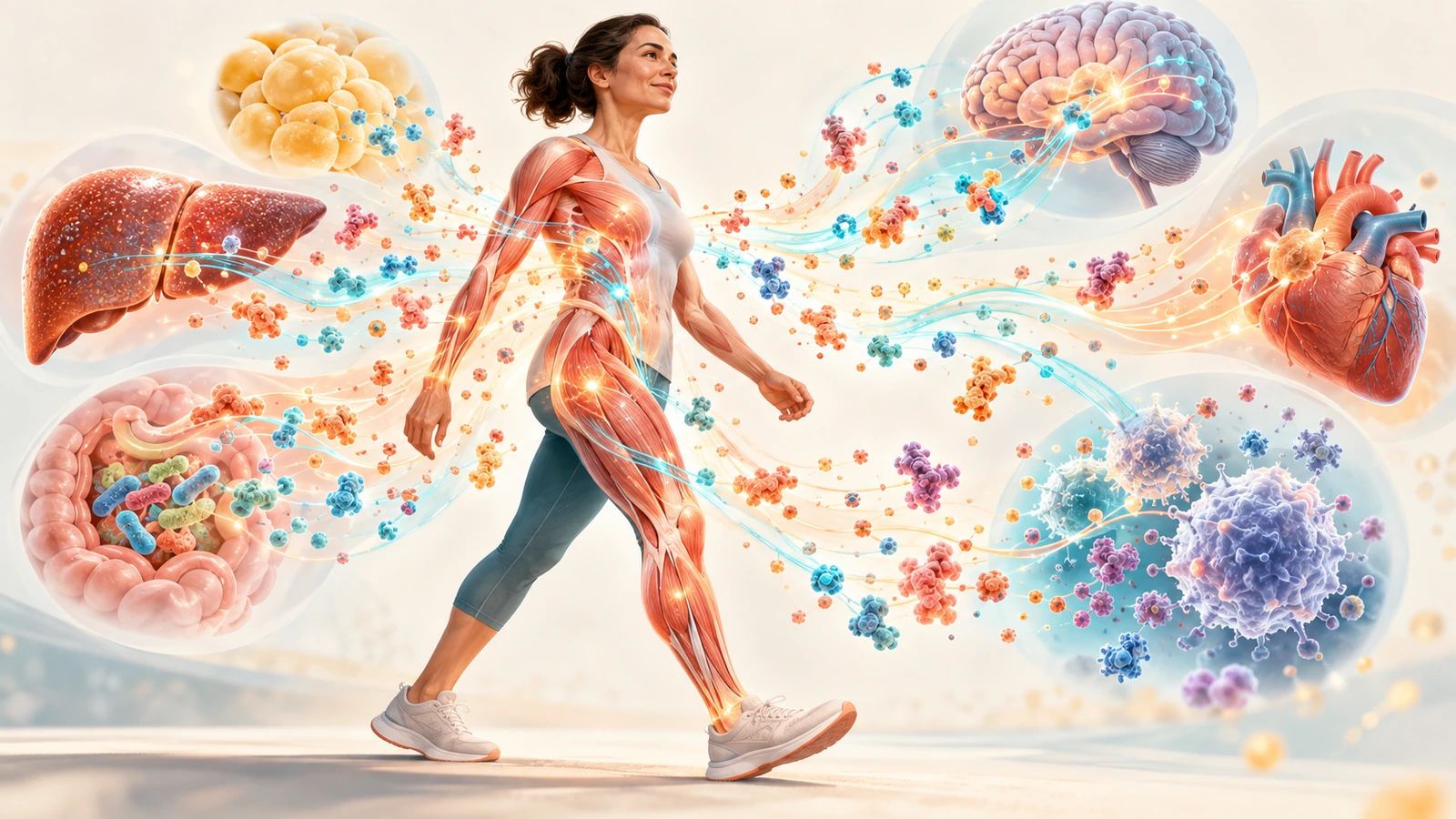
When you get up from a chair, walk to the kitchen, climb a flight of stairs, or pedal a bicycle, your muscles do the obvious job: they contract and move you.
But something less visible happens too.
Muscle cells increase their demand for fuel. Chemical signals shift. Proteins in your bloodstream change. Your immune and metabolic systems respond to the work you are doing. Some of those changes fade quickly; others can still be measured later.
We have known for a long time that movement benefits health. What scientists are now beginning to map, with extraordinary detail, is what your body is doing behind the scenes.
In October 2026, researchers published an unusually detailed snapshot of that molecular activity. Instead of looking only at heart rate or calories, they measured thousands of proteins in three different body fluids after a single workout. The results help explain why exercise is much bigger than one muscle, one number, or one trip to the gym. Read the new Nature Metabolism study.
The short version
- Your muscles are metabolically active tissue. They use fuel, respond to hormones, and participate in chemical communication with the rest of the body.
- A single workout changes far more than heart rate. A 2026 study found 3,007 proteins with significant changes immediately after 45 minutes of cycling, across the body fluids tested.
- Different body fluids tell different parts of the story. The timing of protein changes in plasma, saliva, and urine was not identical.
- Moving muscles can take up glucose through a mechanism distinct from insulin signaling. That is one reason physical activity matters for metabolic health.
- Small opportunities to move may be worthwhile, but one brief clinical study does not prove that four minutes a day can replace a broader activity routine.
Your muscles are more than motors
Most of us learned about muscles as things that pull on bones: biceps bend elbows, quadriceps straighten knees, and calf muscles help us walk.
That is true, but incomplete.
Skeletal muscle is also one of the body's major users of glucose. It can take glucose out of the blood, use it to make energy, and store some of it as glycogen for later. Muscle tissue responds to insulin, and muscle contraction itself activates additional glucose-uptake mechanisms. Explore the physiology review.
Researchers also study molecules released during or after physical activity that can influence nearby cells or distant tissues. These are sometimes called exerkines. When a signaling molecule comes from muscle, it may be called a myokine. Other tissues, including the liver and fat tissue, can contribute exercise-responsive signals as well.
Think of it less like a muscle shouting one message and more like an orchestra in which many instruments change what they play. Some signals help coordinate fuel use; others are involved in inflammation, recovery, and tissue adaptation. Scientists are still working out which changes are causes of long-term benefits, which are consequences of the exercise itself, and which are simply associated with it. Read the exerkine review.
What scientists found in 2026
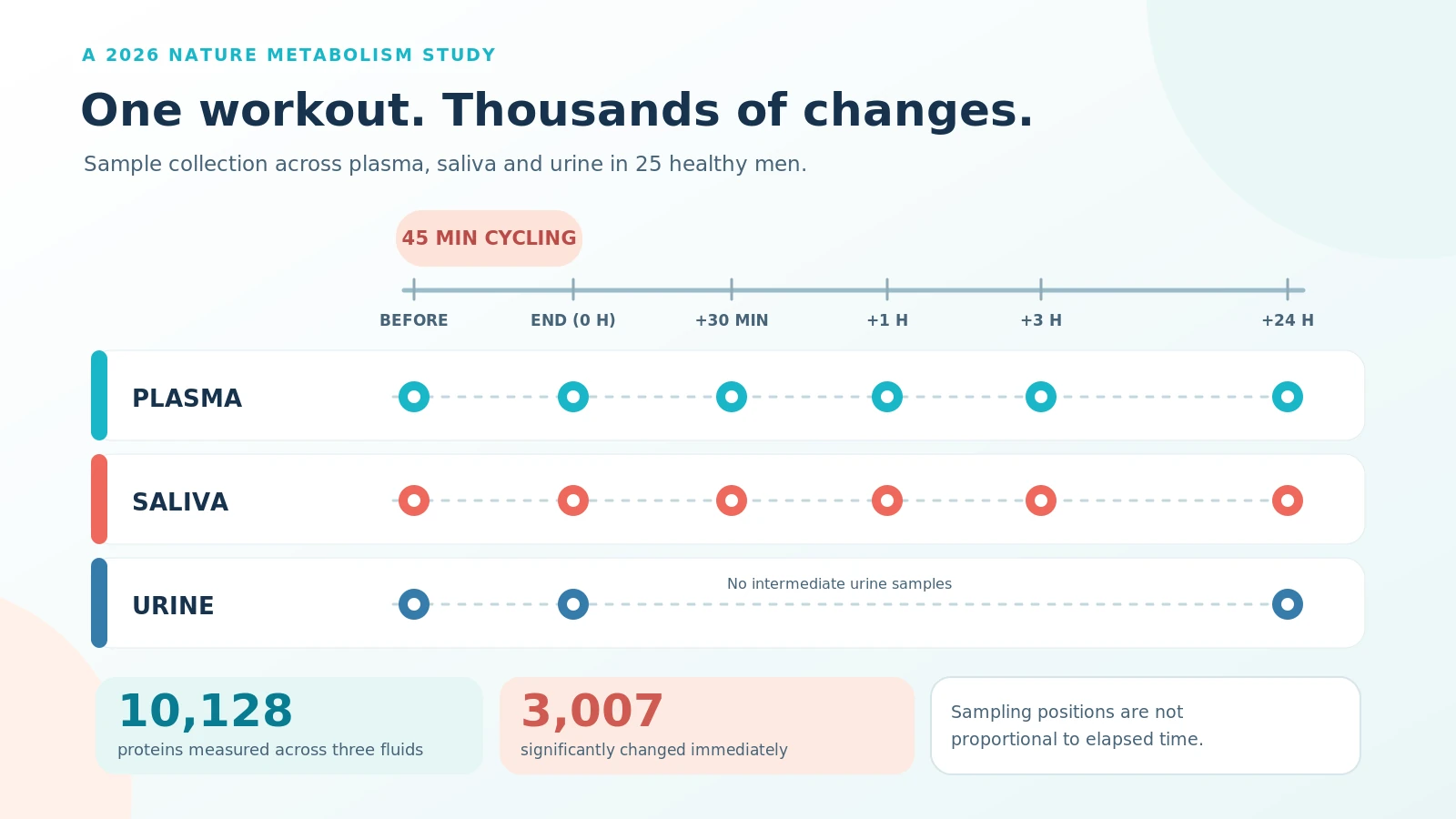
In the study published on October 12, 2026, in Nature Metabolism, 25 healthy young men completed 45 minutes of moderate-intensity cycling. The researchers collected blood plasma and saliva before exercise and repeatedly during the following 24 hours. They also collected urine before exercise, immediately afterward, and at 24 hours. Kurgan and colleagues, 2026.
Across the three body fluids, the team measured 10,128 proteins using high-throughput proteomics. Of those, 3,007 showed statistically significant changes immediately after exercise.
That is the exciting number. But its meaning is important: these were changes in measured protein abundance across body fluids. It does not mean that the researchers discovered 3,007 new hormones, proved that all 3,007 proteins carry messages between organs, or showed that every change is beneficial.
The details were fascinating in their own right:
- Plasma, the liquid part of blood, showed many rapidly changing proteins around the end of the cycling session.
- Saliva showed a different pattern, with some protein changes still detectable during recovery at 24 hours.
- Urine showed a more limited, transient protein response, with the study's exercise-associated changes resolving by the 24-hour sample.
The study also found correlations between protein patterns across fluids and connected some exercise-responsive proteins to existing genetic evidence about cardiometabolic disease. The researchers checked many plasma-protein responses in a separate cohort, and explored selected candidate proteins in fruit flies to investigate possible biological functions. Those added steps strengthen the research, but they do not by themselves prove that the same molecules produce a particular clinical benefit in humans.
Why blood, saliva, and urine?
Imagine trying to understand a busy city by listening only to the traffic on one street.
Blood can show signals circulating throughout the body, but it is not a complete record of what is happening in every tissue. Saliva reflects activity involving the salivary glands, oral tissues, and some broader physiological signals. Urine reflects filtration, excretion, and kidney-related processes. The three sources overlap, but they also offer different windows into the body's response.
That is why the new atlas matters. It is a richer research map, not a test that lets anyone diagnose their metabolic health from a saliva or urine sample after a walk.
It also matters who took part: the main experiment involved 25 healthy young men doing one specific kind of exercise. Responses may differ with age, sex, training status, health conditions, medications, and activity type. The replication analysis helps with some of those questions, but it cannot erase every limitation of the original experiment.
How moving muscles help manage glucose
Here is where the new molecular story connects to something very practical: blood sugar.
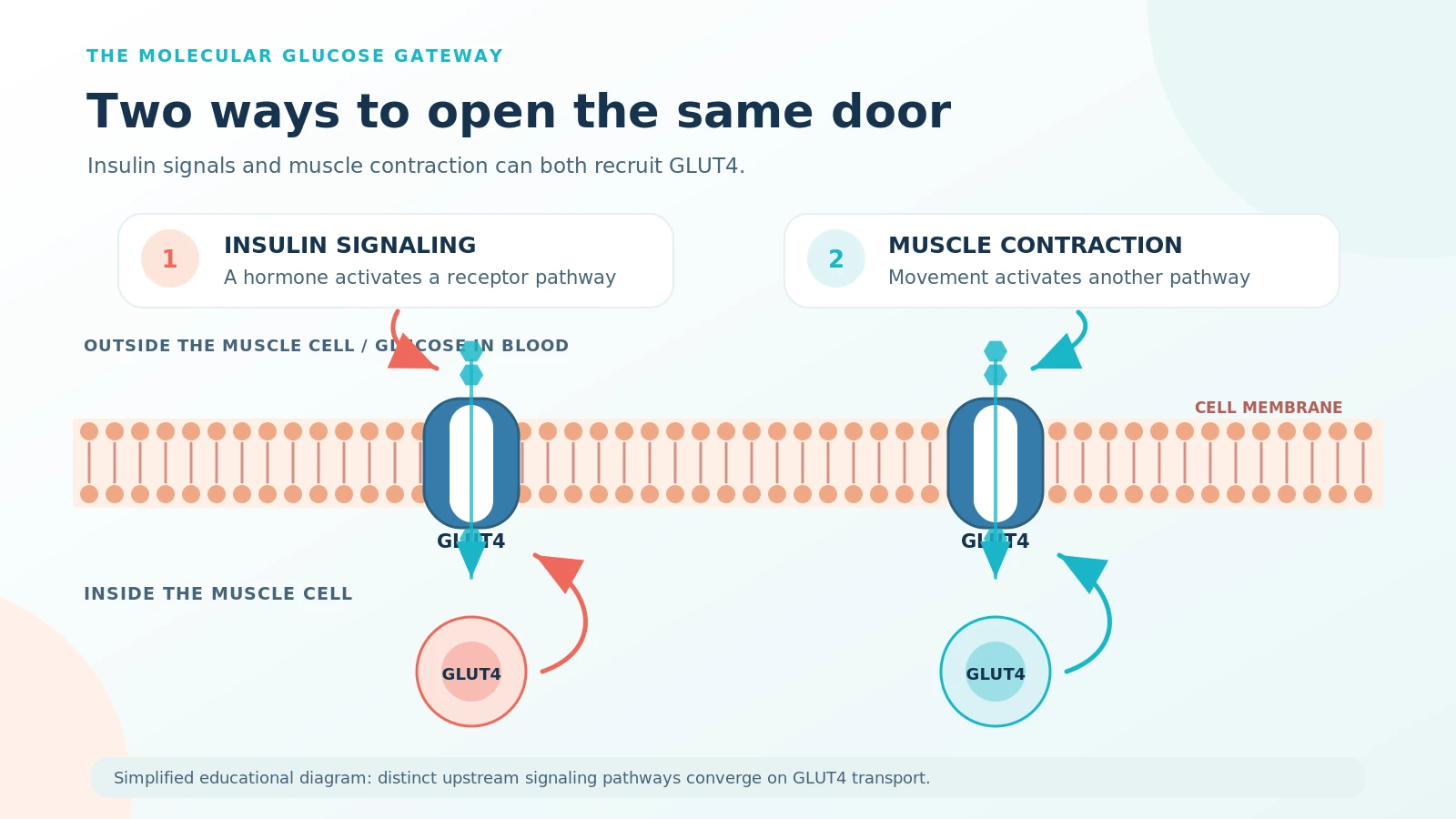
After you eat carbohydrates, glucose enters the blood. Insulin is one of the main signals telling muscle cells to bring more glucose inside. It helps move a transporter called GLUT4 to the muscle-cell surface, where it acts as a gateway for glucose.
But insulin is not the only way to get that gateway working.
Muscle contraction activates a partly distinct pathway that can also move GLUT4 toward the cell surface, increasing the muscle's ability to take up glucose during activity. It is not a replacement for insulin, and the biology involves several signaling steps. It does explain why physical activity can change glucose handling even without a meal or an insulin spike at that exact moment. Richter, Bilan, and Klip, Physiological Reviews.
This is not a promise that glucose always falls after exercise. Especially with more intense effort, stress hormones can sometimes cause glucose to rise for a period. Medication, recent meals, sleep, and individual biology also influence what happens.
If you read our earlier article Why the Same Meal Can Affect Your Body Differently Every Day, this is one more piece of that puzzle: what happens after a meal depends on what your muscles are doing, too.
Can even one minute of movement make a difference?
A separate study published in Diabetologia in April 2026 asked a small but interesting question: do short bursts of activity spread through the day change glucose patterns in people with type 2 diabetes?
Researchers studied 31 previously inactive adults with well-controlled type 2 diabetes who were not taking insulin. Participants completed a randomized crossover experiment comparing two days with no exercise against two days with four one-minute bouts of vigorous bodyweight exercise per day. Diet was standardized, and glucose was tracked with continuous glucose monitors. Babir and colleagues, 2026.
The short activity bouts produced small improvements in several measures of glucose variability and after-meal high glucose. But the study's comparison of average glucose did not reach statistical significance. The researchers did not show that these changes persist for months, prevent complications, or substitute for regular physical activity.
Also, the participants were doing vigorous exercise, not simply standing up for one minute. Those are not interchangeable activities, and this trial was not conducted in people with type 1 diabetes or insulin-treated type 2 diabetes.
So what is the sensible interpretation?
Short periods of activity are worth studying, and they can be part of a healthier day. But this small, short trial is not proof that four minutes is all anybody needs.
What happens when sitting fills the day?
Think about a typical workday: breakfast, a long commute, hours at a desk, lunch, more sitting, and a quiet evening. Even if you exercise deliberately, there may be long stretches when your large muscles are hardly moving.
Long periods of sitting are one reason health researchers also study movement breaks: brief interruptions in sedentary time rather than a single workout that has to carry the whole day.
The American Diabetes Association's 2026 Standards of Care advise people with diabetes to interrupt prolonged sitting at least every 30 minutes when practical, with brief standing, walking, or other light movement. The same guidance encourages gradual increases from a person's own baseline. For most adults with diabetes, it also recommends aiming toward at least 150 minutes a week of moderate-to-vigorous aerobic activity, along with individualized activity planning.
Worldwide, the World Health Organization similarly emphasizes that every amount of physical activity counts and recommends 150 to 300 minutes of moderate aerobic activity per week, or an equivalent amount of vigorous activity, for adults, along with muscle-strengthening activities.
That leaves room for ordinary, human-sized choices. Walking to another room. Taking a gentle lap after lunch. Dancing while making dinner. Moving or wheeling in ways that work for your body. Getting outside with a friend. None of those actions has to be presented as a heroic fitness transformation to be worthwhile.
If you'd like to make outdoor movement safer and more enjoyable, our Summer Walks, Hydration, and Diabetes article offers practical ideas.
What this science does - and does not - tell us
There is a difference between measuring a molecule after exercise, understanding the mechanism behind that change, and proving that changing the molecule prevents a disease.
The 2026 protein atlas takes us further with the first step and opens questions about the second. It does not answer every question about the third.
Likewise, the exercise-snack trial measured short-term glucose patterns, not future heart attacks, dementia, or diabetes complications. We should be curious about those longer-term questions without pretending the answers are already here.
Exercise also needs to fit the person. If you use insulin or a medication that can cause low blood sugar, physical activity may require individualized glucose monitoring, food planning, or medication guidance. If you have cardiovascular symptoms, mobility limitations, or a condition that affects exercise tolerance, ask your healthcare team which forms of activity and intensity are appropriate. Do not use a blog article to change medication doses.
The most useful takeaway is not a perfect number
A minute of movement is not a magic prescription, and one workout is not a molecular reset button.
But your body is responding whenever you move. Some changes are immediate and well understood, like the increased fuel demands of contracting muscle. Others, including the many proteins uncovered by the new atlas, are part of an emerging scientific story.
That perspective changes the question from "Did I burn enough calories?" to something more interesting:
"What small, repeatable ways can I help my body move today?"
Notice patterns, not perfection - with Memovela
Memovela, the wellness app from Mindful Diabetes Inc., lets you track activities, movement-related goals, and other daily habits over time. You can use those records to notice whether short walks, regular movement breaks, or different routines are becoming part of your life.
It is a tool for personal reflection and consistency, not for measuring exerkines or diagnosing a glucose response. You do not need a perfectly optimized day for a small step to count.
Small steps, strong habits.
Key takeaways
- The new 2026 proteomics study identified thousands of exercise-associated protein changes across blood plasma, saliva, and urine after one cycling session.
- Not every changing protein is an exerkine, a proven message between organs, or a demonstrated health benefit.
- Contracting muscles can increase glucose uptake through signaling that is partly independent of insulin.
- Short bursts of vigorous movement showed small short-term glucose improvements in one trial of 31 adults with non-insulin-treated type 2 diabetes; average glucose was not significantly lower.
- Movement breaks can complement, not replace, broader physical-activity recommendations.
- The most realistic habit is one that is safe, accessible, and repeatable for you.
Medical note: This article is educational and is not a substitute for diagnosis, treatment, or individualized exercise advice. People using insulin or medicines that can cause hypoglycemia should discuss activity plans and glucose monitoring with their healthcare team.
Scientific references
- Kurgan N, Kjaergaard J, Jespersen NZ, et al. Systemic proteomic dynamics of acute exercise reveal genetic links to health and disease. Nature Metabolism. Published October 12, 2026. DOI: 10.1038/s42255-026-01621-w.
- Babir FJ, Marcotte-Chenard A, Sandilands RE, et al. Exercise snacks performed in real-world settings reduce postprandial hyperglycaemia and glycaemic variability in individuals living with type 2 diabetes: a randomised crossover study. Diabetologia. 2026;69:2200-2211. DOI: 10.1007/s00125-026-06741-2.
- Richter EA, Bilan PJ, Klip A. A comprehensive view of muscle glucose uptake: regulation by insulin, contractile activity, and exercise. Physiological Reviews. 2025;105(3). DOI: 10.1152/physrev.00033.2024.
- Chow LS, Gerszten RE, Taylor JM, et al. Exerkines in health, resilience and disease. Nature Reviews Endocrinology. 2022;18:273-289. DOI: 10.1038/s41574-022-00641-2.
- American Diabetes Association Professional Practice Committee. Facilitating Positive Health Behaviors and Well-being to Improve Health Outcomes: Standards of Care in Diabetes - 2026. Diabetes Care. DOI: 10.2337/dc26-S005.
- World Health Organization. WHO guidelines on physical activity and sedentary behaviour. Published November 25, 2020. Read the guidelines.